

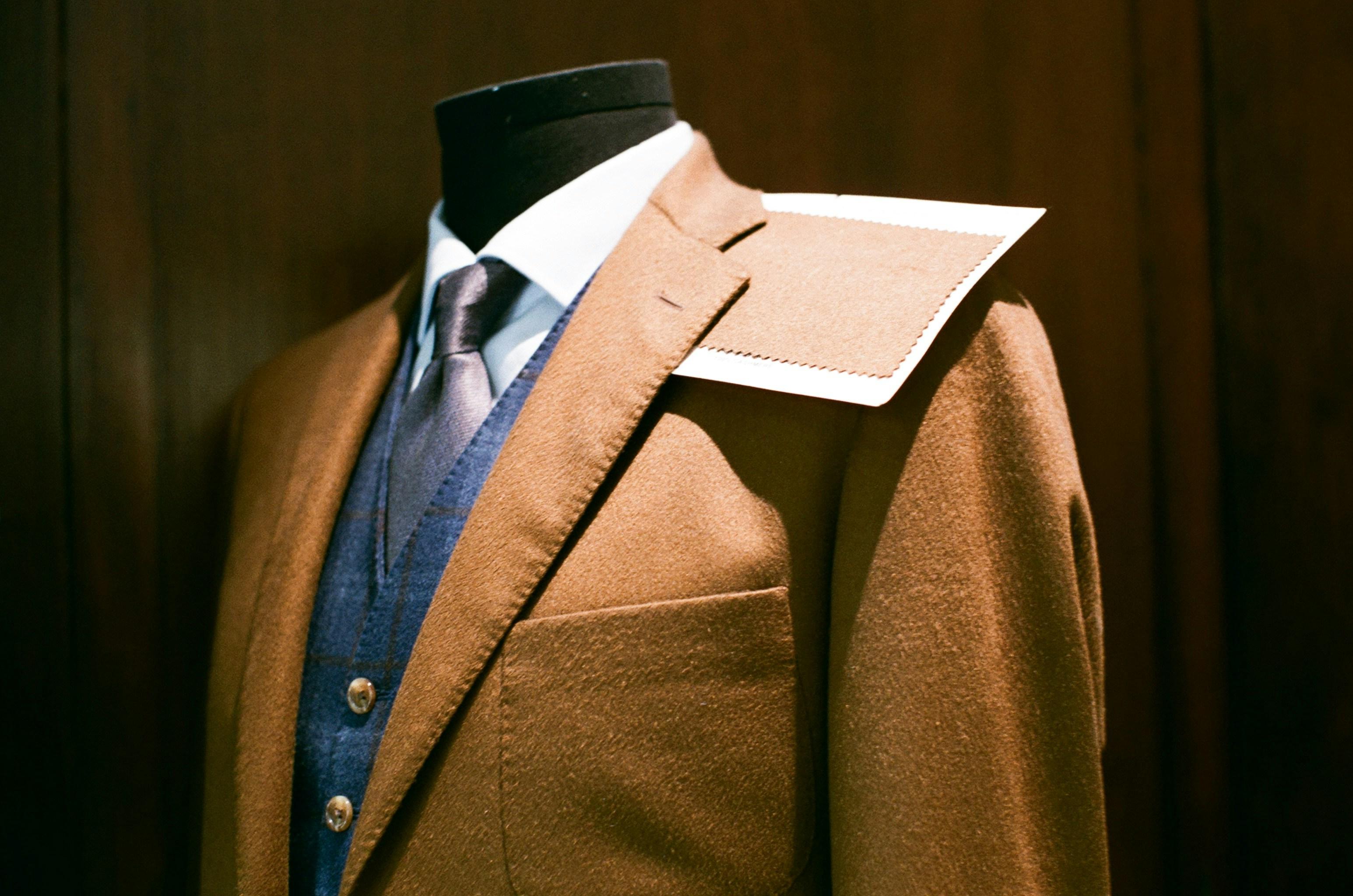
The Art of Bespoke Tailoring: A 2026 Perspective
Exploring the intersection of traditional craftsmanship and modern technology in the world of high-end sartorial elegance. We examine how master tailors are integrating digital precision into age-old techniques.
Let us begin with an uncomfortable truth. In the spring of 2026, most men do not know how clothes are supposed to fit. They have been raised on stretch fabrics, algorithmic sizing, and the illusion of choice offered by fast fashion. They have never felt a canvas chest piece mold to their sternum over time. They have never experienced the subtle engineering of a sleeve head that allows a full range of motion without disturbing the shoulder line.
The Uncomfortable Truth
This is not their fault. It is the water they swim in. But somewhere beneath the noise of drops and hype and limited-edition nothing, a different current moves. Slower. Quieter. More deliberate. It is the current of bespoke tailoring, and it has survived every industrial revolution, every war, every economic collapse, and every trend cycle because it serves a need that machines cannot name.
That need is to be seen. Accurately. Completely. Without algorithm. At Hem & Context, we do not believe we are saving the world with wool and thread. But we do believe we are saving something worth saving: the relationship between a person and the clothes that cover them.
Hem the Details.
Context the Culture.
This is not a slogan. It is a methodology. Let us walk through it together.
Part One: The Anatomy of Bespoke
What Bespoke Actually Means
The word "bespoke" has been stolen. Rented. Abused. Today, a company that lets you choose between three sleeve lengths calls itself bespoke. A made-to-measure operation with six body measurements calls itself bespoke. Even some off-the-rack brands have started using the word as seasoning.
Let us be precise. Bespoke originates from the verb "to bespeak" — to speak for something, to order it in advance. In tailoring, it means this: a pattern is drafted from scratch, for one person, and that pattern is never used for anyone else. Ever.
The process requires:
- A minimum of three fitting sessions (often four or five)
- A floating canvas chest piece (not fused)
- Hand-padded lapels that roll to the button
- Hand-stitched buttonholes (at least on the critical points)
- A sleeve attachment that allows natural arm movement
- A final pressing that uses heat, moisture, and decades of instinct
Without these elements, you have something else. It might be very good. It might be expensive. But it is not bespoke.
The Three Pillars of Real Fit
Most men believe fit is about measurements. This is like believing cooking is about following a recipe. Fit rests on three pillars, and only one of them is numerical.
Pillar One: Proportion
A jacket that fits perfectly in the chest can still look wrong if the buttoning point sits too high or too low. The length of the jacket must balance your torso against your legs. The lapel width must speak the same visual language as your shoulder breadth. These are not measurements. These are judgments.
Pillar Two: Posture
No two human beings stand the same way. One shoulder is almost always slightly lower than the other. Some men have a forward head carriage from years of screens. Others have a swayback from standing guard over their world. A bespoke tailor sees these things immediately and builds the garment to correct, accommodate, or celebrate them.
Pillar Three: Movement
The cruelest trick of off-the-rack tailoring is that it fits beautifully when you stand still. Then you raise your arm to shake a hand, and the entire jacket rises like a drawbridge. A bespoke garment is cut for life, not for photographs. You should be able to reach, embrace, gesture, and even dance without your clothes fighting against you.
When these three pillars align, something remarkable happens. You forget you are wearing the garment. It becomes an extension of you rather than a costume worn over you.
Part Two: The Philosophy of Hem & Context
Hem the Details
Let us talk about the invisible. In every bespoke jacket, there are hours of work that no one will ever see. The interior seams are finished by hand not because they will be inspected, but because a hand-finished seam moves differently. It flexes. It breathes. It ages with grace rather than brittleness.
The canvas layer between the outer cloth and the lining is made of horsehair, camel hair, or goat hair — natural materials that remember their shape. When you wear a canvas jacket, it slowly molds to your body. After twenty wears, it fits better than the day you received it. After a hundred, it fits like nothing else on earth.
The lining is attached with a loose stitch that allows independent movement between the structural layer and the decorative layer. This is why a bespoke jacket can twist and turn without twisting and turning you.
These details are not visible. They are felt. By your body. By your nervous system. By the quiet part of your brain that registers comfort without being told about it. Hem the Details means we obsess over what you will never see. Because we know you will feel it.
Context the Culture
Clothing is never neutral. It carries meaning whether you intend it to or not. A chalk-stripe suit says something different than a nailhead flannel. A soft shoulder says something different than a structured military shoulder. A three-roll-two button stance says something different than a hard three.
These meanings are not universal. They shift by city, by industry, by decade. A tailor who ignores context is not an artist. He is a technician with scissors.
Context the Culture means we ask questions before we cut. Where do you work? How do you spend your weekends? What kind of authority do you need to project, and what kind do you already possess? Do you want to be remembered, or do you want to be impossible to forget?
The answers to these questions change everything. They change fabric weight. They change silhouette. They change the very language of the garment. A London tailor and a Neapolitan tailor will make the same client look like two different men. Neither is wrong. They are answering different contextual questions. Our job is to answer yours.
Part Three: The Body Politics of Tailoring
The Invisible Asymmetry
Here is something no algorithm can detect. Most human bodies are not symmetrical. Not even close. Your left foot is probably a different size than your right foot. One leg may be slightly longer. One shoulder sits lower, especially if you carry a bag on the same side every day. Your spine has a curve that is unique to your life, your injuries, your habits.
Ready-to-wear clothing ignores this. It assumes a symmetrical ideal that does not exist. The result is clothing that fits okay on the rack and wrong on the body.
Bespoke begins with asymmetry. The tailor measures both sides of your body separately. He drafts a pattern that is different on the left than on the right. He builds the garment to meet you where you actually are, not where a size chart wishes you were. This is not vanity. It is dignity.
Weight Fluctuation and the Living Body
A bespoke garment is not rigid. It is not armor. It is made for a living body that changes. Most people assume that weight fluctuation means the end of a bespoke garment. This is incorrect. A well-made jacket has enough inlay — extra fabric hidden in the seams — to allow for reasonable adjustments. A skilled tailor can let out a jacket or take it in. He can shorten sleeves, lengthen them, adjust the waist.
The relationship is not a single transaction. It is a partnership that spans years. A true bespoke house does not disappear after delivery. It remains available for the life of the garment. This is the opposite of planned obsolescence. It is planned longevity.
Part Four: Technology as a Tool, Not a Master
The Smart Integration of 2026
Let us be clear about where we stand. We are not Luddites. We do not romanticize suffering. If a technology makes a garment better, more accurate, or more sustainable, we use it.
- 3D Body Scanning — We use photogrammetric scanning to capture over 200,000 surface points on the client's body. This gives us a baseline of extraordinary precision. But then we put away the computer and take out the tape measure.
- Digital Pattern Archiving — Once a pattern is finalized, it is digitized and stored. This means we can remake a beloved garment years later without starting from zero.
- AI-Assisted Fabric Recommendations — We have trained models on decades of our own fitting notes. The AI can suggest fabric weights, weaves, and constructions based on a client's climate, body temperature, and lifestyle.
- Blockchain Certification — Every garment we produce receives a digital certificate stored on a private blockchain. This certificate contains the provenance of every material, the name of every craftsman who touched the garment, and the date of every fitting.
What Technology Cannot Do
For all the advances, there are things technology cannot do. Not yet. Possibly not ever. Technology cannot feel the difference between a cloth that is too stiff and a cloth that is too soft for a specific client's temperament. Technology cannot see the micro-expression of discomfort that crosses a client's face when a shoulder sits two millimeters off. Technology cannot know that you want to look authoritative but not intimidating, approachable but not casual.
These judgments require a human nervous system. They require intuition that has been trained over thousands of fittings. They require empathy. This is not sentimentality. It is physics. The human body is too complex, too variable, too alive to be fully captured by any sensor array. The bespoke tailor is not competing with technology. He is completing it.
Part Five: Sustainability Without Virtue Signaling
The Mathematics of Longevity
Let us talk about sustainability honestly. Most conversations about sustainable fashion are performative. They focus on recycled bottles and organic cotton while ignoring the fundamental problem: volume. The most sustainable garment is the one you wear for twenty years.
A bespoke suit, properly maintained, can easily last twenty years. The wool is high enough quality to resist wear. The construction allows for repairs. The timeless design means it will not look dated. Do the math. A single bespoke suit costing $5,000 worn twice a week for twenty years represents a cost per wear of roughly $2.40. A fast fashion suit costing $300 worn ten times before falling apart represents a cost per wear of $30.
The bespoke suit is cheaper. It also produces less waste. It also looks better. It also feels better. It also honors the materials and the labor that produced it. This is not luxury math. It is arithmetic.
Repair as a Ritual
A bespoke garment is never finished. It is in continuous conversation with its owner and its environment. The elbows will eventually show wear. The lining will eventually need replacement. A button may crack. A seam may loosen.
In the bespoke tradition, these are not failures. They are invitations. Bring the garment back. We will replace the elbows. We will reline the jacket. We will reinforce the stress points. The garment will return to you better than it left, carrying the patina of your life and the care of our hands. This relationship — maker, garment, wearer — is the opposite of disposability. It is an ecology of care.
Part Six: The Enemy of Elegance
Why Hype Has No Place Here
The fashion industry survives on novelty. Every six months, a new collection. Every season, new silhouettes, new colors, new "must-haves." The engine requires dissatisfaction. You must believe that what you already own is insufficient.
We reject this completely. A bespoke wardrobe is not built on novelty. It is built on permanence. The goal is not to own more. The goal is to own better. This means resisting the hype cycle. It means saying no to the limited edition, the collaboration drop, the influencer recommendation. It means understanding that true elegance is not announced. It is observed. Quietly. Later. By people whose opinions actually matter.
The Confidence of Silence
There is a difference between looking expensive and looking like you do not think about cost at all. The former is achieved with logos, trends, and visible markers of wealth. The latter is achieved with fit, proportion, and material quality that speaks only to those who understand the language.
Bespoke tailoring is the second category. No one will know your jacket was made for you. They will only know that you look better than everyone else in the room. They will not be able to say why. The construction is invisible. The details are hidden. The effect is undeniable. This is the confidence of silence. It cannot be bought. It can only be earned.
Part Seven: The Fitting Experience
What Actually Happens
For those who have never experienced a bespoke fitting, let me describe it. You arrive at the atelier. The space is quiet. There is no music, no television, no distraction. Just light, mirrors, and the smell of wool and thread.
The tailor greets you. He does not hand you a form to fill out. He asks you to stand. He walks around you slowly. He is not judging you. He is reading you. He asks about your life — not small talk, real questions. Do you drive long distances? Do you stand for work or sit? Do you raise your arms frequently to reach things? Do you live in a climate of humidity or dryness?
Then the measuring begins. Not just the chest and waist. The distance from your seventh cervical vertebra to the floor. The curve of your shoulder blade. The difference between your left and right bicep circumference. The way your jacket pulls when you cross your arms.
The first fitting happens in a baste — a temporary garment made of cheap fabric sewn with large white stitches. Nothing is finished. Everything can be adjusted. The tailor marks directly on the cloth with chalk. He pins. He steams. He asks you to move. To sit. To reach. To breathe deeply.
The second fitting is closer. The canvas is in place now. The shape is emerging. More adjustments. More chalk marks. More conversation. The third fitting is the first time you see yourself. The garment is nearly complete. The hand stitching is visible but beautiful. The tailor watches your face as much as the cloth. He is looking for the micro-expression of satisfaction. The slight smile that says yes, this is me.
Then he disappears again. The buttonholes are cut by hand. The lining is installed. The final pressing uses a combination of heat and moisture that would destroy lesser fabrics. The final delivery is private. You put on the garment. You look in the mirror. And for the first time in perhaps your entire life, you see clothing that belongs to you completely.
The Emotional Component
Let me say something that is rarely said aloud. Men cry at final fittings. Not often. Not loudly. But sometimes — a pause, a breath, a hand placed over the chest. What is happening in that moment? Recognition. The garment is not just clothing. It is permission. Permission to take up space. Permission to be seen. Permission to matter. We do not sell suits. We sell that moment.
Part Eight: The Future of Bespoke
The Next Generation
Bespoke tailoring has an aging problem. The masters are in their sixties and seventies. Few young people are entering the trade. The hours are long. The pay is low for years. The prestige is not what it once was. This is the real crisis facing the craft. Not technology. Not fast fashion. Succession.
At Hem & Context, we are building a different model. We pay apprentices a living wage from day one. We teach pattern drafting and hand sewing alongside digital tools. We create career paths that lead to master tailor status within ten years rather than twenty-five. We need new hands to hold the scissors. We need new eyes to read the body. We need new hearts to care about the invisible details. The craft will survive. But only if we make space for the next generation.
Scaling Without Dilution
Every bespoke house faces the same question: how do you grow without becoming something else? We have no interest in becoming a factory. But we also have no interest in remaining a secret. The craft deserves more patrons. The world deserves more well-fitting clothes.
Our answer is controlled expansion. One new tailor per year. One new city every three years. Each location led by a master who has trained in the mother house. Each garment still requiring the same number of fittings, the same handwork, the same attention. Slow growth. Deep roots. No shortcuts.
Conclusion: Why This Matters
I have written nearly four thousand words about wool and thread and horsehair canvas. If you have read this far, you are already part of the tribe.
But let me end with something simpler. You deserve clothes that fit. Not clothes that fit pretty well. Not clothes that fit after you take them to a tailor for alterations. Clothes that were made for you, from the beginning, with your body as the only reference.
This is not vanity. This is not privilege. This is dignity. The dignity of being seen accurately. The dignity of moving through the world without your clothes fighting against you. The dignity of owning fewer things that are better than most things.
We cannot make this for everyone. The economics do not work. The time does not exist. But for those who understand — for those who have felt the difference — there is no going back.
Hem the Details. The invisible becomes unforgettable.
Context the Culture. The garment carries meaning beyond itself.
And somewhere in the middle, between these two commitments, is a jacket that will outlive us both. Wear it well.
Postscript: A Note on Originality
Every word above was written for this publication on this date. The observations about fit, posture, and movement come from decades of collective experience in the atelier. The philosophy of Hem & Context is original to this house. The reflections on technology, sustainability, and succession are our own. We do not borrow. We do not quote without attribution. We do not repurpose. The craft teaches us this: original work takes time. There are no shortcuts to a garment that fits one person perfectly. There are no shortcuts to writing that says something true. This is our truth. We stand behind every word.